Book Series vs. One-Off Books on Amazon KDP: Which Earns More?
The data is clear: series outperform standalone books on KDP in lifetime revenue, algorithm visibility, and marketing efficiency. Here's the math and real-world proof across every book category.
Why Publishing a Book Series Beats a One-Off Book on Amazon KDP
If you're deciding between publishing a single standalone book or committing to a series on Amazon KDP, the data is overwhelming: series outperform one-off books in almost every measurable way — lifetime revenue per reader, algorithmic visibility, marketing efficiency, and long-term passive income.
This isn't just theory. Across fiction, coloring books, puzzle books, children's activity books, and non-fiction, publishers who build series consistently earn more than those who publish standalone titles. Here's the evidence, the math, and the real-world anecdotes behind why series win.
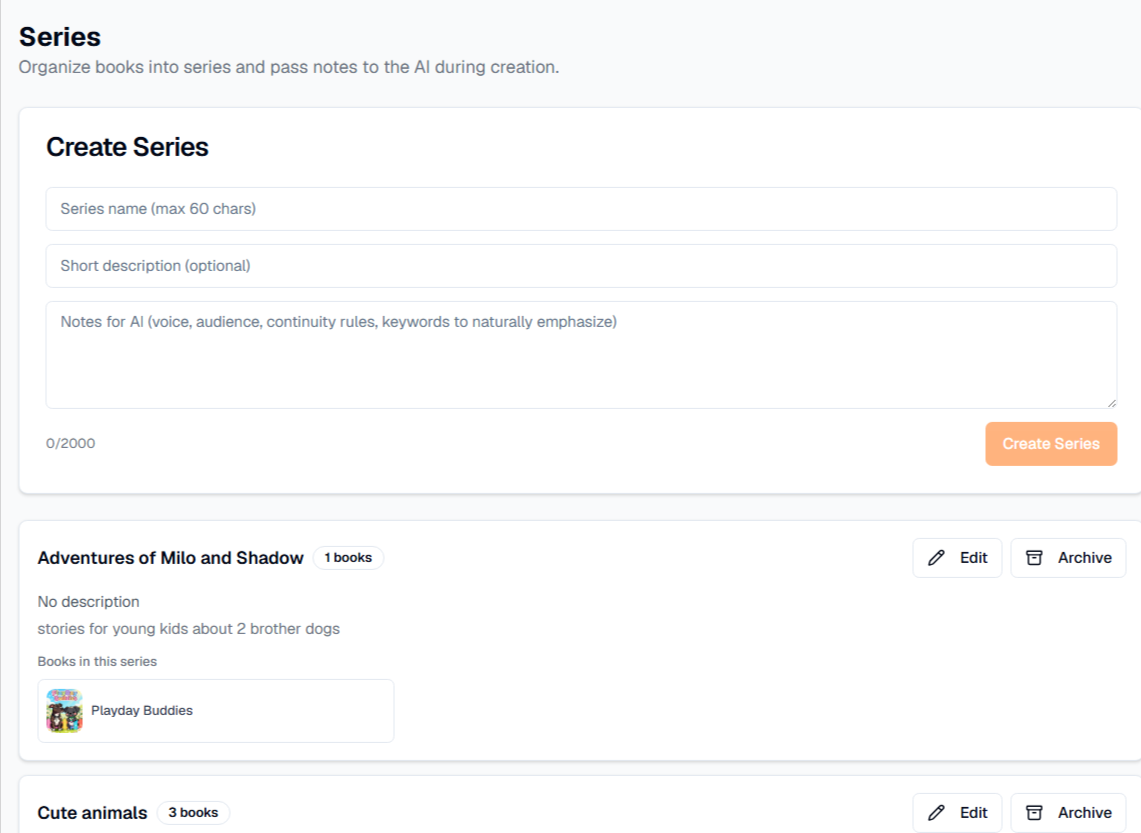
BookCreatorStudio has a built-in Series feature that makes this strategy easy. You can create a named series, set voice/tone and audience rules, and add Notes for AI (up to 2,000 characters) with continuity rules, character descriptions, and keywords. Every book you create within that series automatically inherits those notes — so your characters, style, and theme stay consistent across the entire catalog. It's purpose-built for the exact strategy this article recommends.
A standalone book earns you one royalty per reader. A five-book series earns you three to five royalties from the same reader — with zero additional customer acquisition cost. That compounding effect is the single biggest lever in self-publishing income.
The Core Math: Read-Through Rate Changes Everything
The income advantage of series over standalones comes down to one metric: read-through rate. That's the percentage of readers who finish Book 1 and go on to buy Book 2, then Book 3, and so on. 1
Here's a concrete example from financial modeling by author Vinayak Ramesh. Imagine 500 readers buy Book 1 of a four-book series priced at $4.99 each 2:
- At 25% read-through: Book 1 earns $6,000, Book 2 earns $1,500, Book 3 earns $372, Book 4 earns $96. Total: $7,968 — that's $15.94 per reader acquired.
- At 50% read-through: Book 1 earns $6,000, Book 2 earns $3,000, Book 3 earns $1,500, Book 4 earns $756. Total: $11,256 — that's $22.51 per reader.
- At 65% read-through: Book 1 earns $6,000, Book 2 earns $3,900, Book 3 earns $2,532, Book 4 earns $1,644. Total: $14,076 — that's $28.15 per reader.
Same 500 readers. Same price. The difference between 25% and 65% read-through is over $6,000 in additional revenue — without acquiring a single new reader.
At 65% read-through, each Book 1 buyer is worth $28.15 over the series. That means you can afford to spend up to $14 per reader on advertising and still break even — double what a standalone author can spend. Series economics make paid ads actually profitable.
Real Earnings Data: Series Authors vs. Standalone Authors
The income data across surveys tells a consistent story. According to the Written Word Media 2025 Indie Author Survey and ALLi's 2025 Income Survey, reported by Book Builder and Vappingo 34:
| Catalog Size | Median Monthly Income | Typical Structure |
|---|---|---|
| 1-3 books | Under $100 | Mostly standalones |
| 5-10 books | $500-$1,500 | Early series or mixed catalog |
| 11-20 books | $1,500-$3,500 | 2-3 completed series |
| 30+ books | $3,000+ | Multiple series, established brand |
The pattern is clear: income scales with catalog depth, and series are the vehicle that makes depth work. Authors earning $10,000+ per month almost universally have at least one completed series of 5+ books. 5
The "Catalog Effect"
Amazon's recommendation engine treats authors with deeper catalogs as more credible. When someone buys Book 1, Amazon's algorithm surfaces Book 2 through "Next in Series" emails and "Customers Also Bought" placements. Each new book lifts sales of the entire catalog.
A publisher with 20 books typically earns 4 to 6 times the per-book monthly average of a publisher with 5 books. The 50th book often out-earns the first 10 combined. 6
Series Examples by Book Type
The series advantage isn't limited to fiction novels. Here's how it plays out across the most popular KDP categories:
Story Books and Fiction Series
Fiction is where the series model shines brightest. The data shows:
- Romance series: 60-80% read-through from Book 1 to Book 2. Romance readers are voracious — many finish a series in a week. Authors with 5+ book series in KU often generate 50-70% of income from Kindle Unlimited page reads alone. 67
- Cozy mystery series: Consistently over-represented in the $500+/month income brackets. Readers expect 3+ books per series. 4
- Fantasy/sci-fi series: Strong read-through but require more world-building investment. The payoff is that fantasy readers are loyal — once hooked, they buy everything. 1
- Children's story books: Series perform 3:1 against standalones in sustained sales. Characters that recur across books build trust with parents and kids alike. 8
Many successful fiction authors price Book 1 at $0.99 or make it permanently free ("perma-free"). The loss on Book 1 is an acquisition cost — the real revenue comes from readers buying Books 2-5 at full price ($4.99). Publishing.co.uk reports that most indie authors earning six figures from KDP have at least one completed series behind them, often using this exact pricing model. 9
Coloring Book Series
Coloring books are one of the strongest categories for series publishing on KDP. Top brands like Jade Summer and Coloring Book Cafe built empires by releasing books in themed sets. 10
Why series work for coloring books:
- If someone loves "Cute Kawaii Foods Volume 1," they'll want Volume 2 — it's an effortless add-to-cart.
- Amazon starts linking your books together in "also bought" recommendations.
- A recognizable brand (consistent cover style, theme, art style) builds trust and repeat purchases.
Real numbers from coloring book publishers:
- One coloring book can make $1,000+/month in a strong niche — but a five-book series can multiply that to $3,000-$5,000/month, according to coloring book publisher Renee Clancy. 10
- Book Illustration AI's market analysis found that authors with 25+ titles have a median income near $3,000/month, while 80% of authors with 1-3 books earn under $100/month. 11
- The 12-book strategy is common among top performers: 12 books in one niche occupy 12x the digital shelf space, target broader keywords, and help Amazon recognize you as an authority in that niche. 12
Pick a scalable theme (e.g., "Dinosaurs for Kids"), create consistent cover branding, then publish variations: Holiday Dino, Ocean Dino, Space Dino, Farm Dino. Renee Clancy pivoted from standalone coloring books to a holiday dinosaur series and saw 20+ copies in just a few days from a single Valentine's themed title — validating the entire series direction. 10
Puzzle Book Series
Puzzle books are one of the most resilient and scalable categories on KDP. Buyers are repeat customers who consume content quickly — they finish a book and need another one. 13
Why series dominate in puzzle books:
- Puzzle buyers don't browse casually; they shop with intent. When they find a publisher they like, they come back. 14
- Sudoku buyers reportedly work through one book per week and keep buying for years. 15
- A linked catalog of 8-10 books lets each title support the others through series naming and "also bought" placements. 16
Real earnings from puzzle book series:
- PuzzlePage reports their first cryptogram catalog of 8 books hit roughly $1,800/month by month 6 using their niche-stacking system. 16
- Book Review System cites named publishers: Emma's word search series earns $5,000-$7,000/month, Oliver's Sudoku series earns $4,000-$6,000/month, and Helen's senior large-print puzzles earn $10,000-$13,000/month. 14
- A single well-optimized puzzle book might earn $15-$50/month, but publishers with 30-50 books in focused niches often make $500-$2,000+/month. 13
- The puzzle book market generates over $450 million per year and continues growing in double digits. 17
Pick one niche audience (coffee lovers, gardeners, dog owners) and build 10 books around them: a standard edition, a large-print edition, a hardcover edition, and a mixed puzzle bundle. Each format variant targets a different buyer — budget buyers, gift buyers, and premium buyers — from the same audience. 16
Children's Activity Book Series
Activity books for kids (mazes, dot-to-dot, mixed activities) benefit enormously from series publishing:
- Publisher Kristen Walters made $5,608 in a single month from just 3 activity books by targeting high-volume keywords and using Amazon Ads to push into the top 5,000 BSR range. 18
- Publisher YourChicGeek earned over $160,000 in cumulative royalties from 500+ low and medium content books — the game changer was "stopping random one-off books and building book brands." 19
- Kids puzzle series with consistent themes (e.g., "Dinosaur Mazes ages 4-8") can clear $3,000-$5,000/month per series, according to KDPEasy's market data. 6
Custom Character and Brand Series
Some of the most profitable KDP publishers build series around original characters or brand concepts:
- A publisher who created a character-based coloring series with consistent art style and holiday themes saw each new release boost sales of the entire back catalog. 10
- Children's books with recurring characters (a friendly dinosaur, a curious cat) build recognition with parents who become repeat buyers. 8
- The key insight, as articulated by Medium author Yinka Emmanuel: a series is a brand, not just a product. When someone sees your consistent theme, cover design, and art style, they know exactly what they're getting — which increases trust and sales. 20
Building a custom character series? BookCreatorStudio's Notes for AI field (up to 2,000 characters) lets you define your character's personality, appearance, relationships, and recurring settings once — then every book you create in that series automatically inherits those rules. Set voice/tone ("playful and silly for ages 3-6"), describe your characters ("Milo is a brave brown puppy, Shadow is his cautious black cat brother"), and list continuity rules ("they live in a treehouse, Milo always leads adventures, Shadow provides comic relief"). The AI maintains consistency across your entire series without you repeating instructions each time.
When Standalones Actually Win
The series model isn't universally superior. There are specific situations where standalone publishing is the smarter choice:
- Evergreen non-fiction: A well-positioned how-to guide or business book can generate steady income for years without a sequel. Three to five well-positioned standalones in evergreen topics may outperform a non-fiction series. 1
- Market testing: Standalones allow 30-60 day feedback cycles. If you're unsure about a niche, publish one book first to validate demand before committing to a series. 21
- Trend-dependent content: If you're chasing a current trend, speed matters more than series structure. 1
- Authors who can't commit: An abandoned series is worse than no series. Readers who invested in Books 1-3 and expected completion feel burned — and won't trust your next series. 19
The Hybrid Approach: Connected Standalones
Between a strict series and completely disconnected standalones lies a powerful middle ground: connected standalones. These are books that share a universe, recurring secondary characters, or thematic setting — each is self-contained narratively, but readers who enjoy one naturally discover the others.
This model captures many series benefits (cross-discovery, "also bought" associations, brand recognition) without the strict continuation obligation. It's used by some of the most commercially successful authors in both fiction and non-fiction. 1
Series Strategy Cheat Sheet
- 1
Choose a scalable theme
Pick a niche broad enough for 5-12 books but specific enough to attract a defined audience. Example: 'Large Print Sudoku for Dog Lovers' rather than generic 'Sudoku Book.'
- 2
Write or produce 3 books before publishing any
This lets you launch with momentum. Release Book 1, then Book 2 six weeks later, then Book 3 six weeks after that. Amazon's algorithm rewards this cadence. [^9]
- 3
Price Book 1 as a loss leader
Set Book 1 at $0.99 or the minimum viable price. Its job is to acquire readers, not generate profit. Books 2+ are priced at full price ($4.99-$9.99). [^9]
- 4
Build consistent branding
Same cover style, same font, same color palette across all books. Readers should recognize your brand at a glance in search results. [^20]
- 5
Optimize your back matter
Include a 'Continue the Series' page with Book 2's cover, a one-paragraph hook, and a direct purchase link. Add a sample chapter of Book 2 at the end of Book 1. [^1]
- 6
Link books in KDP as a series
Use the Series field during KDP upload. Amazon will display 'In this series (3 books)' on each product page — this drives automatic cross-selling. [^10]
- 7
Launch a box set after Book 3
Bundle Books 1-3 at a discount (e.g., $6.99 if individual books are $4.99 each). Box sets get their own BSR, their own reviews, and their own 'new release' visibility. [^9]
- 8
Keep publishing
Add 1-2 books per quarter. Each new book lifts sales of the entire series. The compounding effect accelerates after Book 5-6. [^6]
The Bottom Line
The financial case for series over standalones on Amazon KDP is clear and consistent across nearly every book category. A standalone book is a product. A series is a business. The compounding economics — where each new reader you acquire generates revenue across multiple books rather than just one — is the single most powerful lever available to self-published authors.
Whether you're writing fiction, creating coloring books, designing puzzle books, or building an activity book brand, the path to sustainable KDP income runs through series. Start with one niche, commit to consistent branding, publish on a steady cadence, and let the compounding do its work.
Sources
How many books do I need in a series before it becomes profitable?+
Is it better to publish a coloring book series or standalone coloring books?+
Do puzzle book series sell better than standalone puzzle books?+
Can I turn existing standalone books into a series?+
What if I start a series but can't finish it?+
How long does it take to see real income from a KDP series?+
🎨 How to Make Coloring Books to Sell
The honest blueprint: revenue data, AI workflows, KDP specs.
💰 KDP Royalty Tiers
The 35% vs 70% math and pricing sweet spots.
📊 Is Amazon KDP Saturated?
Market data on competition, payouts, and opportunity in 2026.
Footnotes
-
Vappingo — "KDP Series vs Standalone Income: A Detailed Financial Comparison". Covers the financial mechanics of read-through rate, worked income scenarios, and when standalones outperform series. ↩ ↩2 ↩3 ↩4 ↩5 ↩6 ↩7
-
Vinayak Ramesh — "Self-Published Authors With a Series Are Playing a Completely Different Financial Game". Financial modeling of read-through scenarios at 25%, 50%, and 65% rates across a four-book series. ↩
-
Book Builder — "How Much Do Indie Authors Earn? (2026 Data)". Aggregates data from the Written Word Media 2025 Indie Author Survey and ALLi's 2025 Income Survey. Reports catalog-size-to-income correlation. ↩
-
Vappingo — "How Much Do KDP Authors Actually Earn? Real Numbers for 2026". Breaks down the Written Word Media 2025 survey: 44% earn $100/month or less, 8% earn over $10,000/month. Genre-level income analysis. ↩ ↩2
-
Vappingo — "$10,000 a Month from KDP: What It Actually Takes". Profile of high-earning KDP authors: typically 15-35 books, concentrated in one genre, 3-6 years to reach $10K/month. ↩
-
KDPEasy — "How to Make Money with Amazon KDP in 2026". Comprehensive income breakdowns by book type. Reports the catalog effect (20 books = 4-6x per-book average of 5 books). Tier 2 fiction series math. ↩ ↩2 ↩3
-
GeteBook.ai — "Kindle Unlimited Strategy: How Indie Authors Actually Earn $5K+/Month". KU page-read economics, 60-80% read-through benchmarks for series, and the 6-12 books/year cadence. ↩
-
PageBeacon — "KDP Children's Book Author Case Study: Real Data Analysis". Reports series outperform standalones 3:1 in sustained children's book sales. Revenue scenarios from $200-$2,450/month. ↩ ↩2
-
Publishing.co.uk — "Series Strategy: How to Build a Sellable Backlist for KDP". Loss-leader pricing model, 75% read-through funnel, rapid release cadence (30-60 days), and the 20-month series launch timeline. ↩ ↩2 ↩3
-
Renee Clancy — "How to Build a Profitable Coloring Book Series on Amazon KDP". Personal anecdote of holiday dinosaur series, $1,000+/month per title, and the KDP Series field setup. ↩ ↩2 ↩3 ↩4
-
Book Illustration AI — "How to Scale a KDP Coloring Book Business (2026)". Catalog income math: 80% of authors with 1-3 books earn under $100/month vs. median ~$3,000 for 25+ titles. Portfolio model (slow movers, steady sellers, strong sellers). ↩
-
Coloring Book Engine — "Why Series Sell: 12-Book Strategy for More Keywords & Repeat Buyers". The 12-book critical mass theory: digital shelf space, entity recognition, and loss-leader pricing for coloring book series. ↩
-
PageBeacon — "Puzzle Books KDP Profitability Analysis 2026". Market data: $2-8 royalty per sale, 40% holiday spike, $500-$3,000/month per active title for successful publishers. ↩ ↩2
-
Book Review System — "How to Sell Puzzle Books on Amazon KDP and Make Money". Named publisher earnings: Emma ($5-7K/month word search), Oliver ($4-6K/month Sudoku), Helen ($10-13K/month senior large-print). ↩ ↩2
-
PuzzlePage — "How to Price a KDP Puzzle Book in 2026". Reports 36-book catalog, Sudoku buyer repeat purchase behavior, and the $9.99 royalty cliff math. ↩
-
PuzzlePage — "Cryptogram Puzzle Books for KDP: Build a Full Catalog". The 10-book matrix strategy, $1,800/month from 8-book catalog by month 6, three-tier pricing structure. ↩ ↩2 ↩3
-
Medium (Six Months In) — "The Toughest Lessons I've Learned Publishing Puzzle Books on KDP". Reports $450M+/year puzzle book market, $400 earned in 6 months, and lessons on series strategy. ↩
-
Kristen Walters — "How I Made $5,608 Last Month With Just 3 Activity Books". Personal case study: 3 activity books at BSR 2,000-5,000 using high-volume keywords and Amazon Ads. ↩
-
YourChicGeek — "Are Low Content Books Still Profitable? Here's How I Made Over $160K". Personal case study: $160,000+ cumulative from 500+ books. Key lesson: "stopped creating random one-off books and started building book brands." ↩
-
Yinka Emmanuel — "Why Authors Should Be Grouping Their Books Into Series". Framework for repositioning standalone books into series. Entry Book → Expansion Books → Capstone Book model. ↩
-
PageBeacon — "Series vs Standalone Books KDP: Complete Decision Guide". Decision framework: series require 6-12 months upfront, $1,500-$3,000 investment. Standalones break even in 30-90 days. Green lights/red flags for starting a series. ↩